
Syllabus
The MUNC syllabus is designed as a progressive computational workflow. Students first acquire the physical and mathematical foundations of radiation transport, then develop programming, data analysis and modelling skills, and finally apply advanced simulation methods to real nuclear technology problems. The programme culminates in a Final Master’s Thesis where students integrate the full workflow in an applied project connected to a real technical environment.
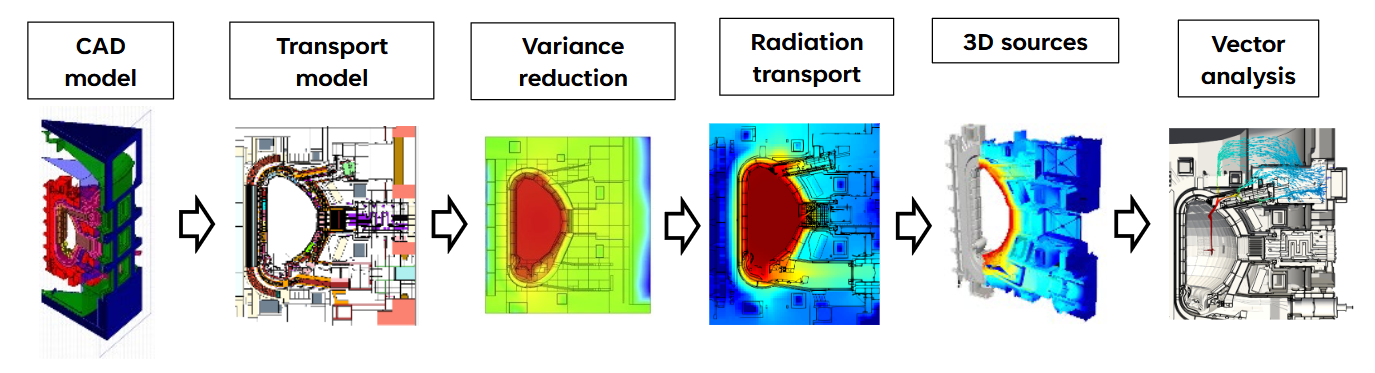
Basics of radiation transport
Semester 1 - 6 ECTS
This course introduces the physical foundations of computational neutronics, including radiation–matter interaction, nuclear data, dosimetry and the main application areas of radiation transport. It provides the conceptual basis needed to understand and interpret neutronics simulations throughout the programme.
Data analysis for computational neutronics
Semester 1 - 6 ECTS
This course develops the programming and data-analysis skills needed to process, interpret and communicate results from computational neutronics simulations. It provides the practical computational basis for working with modern simulation workflows.
Monte Carlo method for radiation transport
Semester 1 - 6 ECTS
This course introduces the Monte Carlo method as a core numerical approach for radiation transport. Students learn its mathematical foundations, how particle interactions are modelled, and how Monte Carlo codes are used to simulate neutron, photon and charged-particle transport.
Temporal evolution of the isotopic inventory
Semester 1 - 6 ECTS
This course focuses on activation and transmutation analysis. Students learn how irradiated materials evolve over time, how radiation transport is coupled with activation calculations, and how these results support design, operation and safety decisions.
Neutronics for nuclear fusion facilities
Semester 2 - 6 ECTS
This course applies computational neutronics to major fusion facilities such as ITER and DONES. Students study their radiation sources, relevant radiation fields and the specific neutronics challenges involved in the design and operation of fusion systems.
Modeling for radiation transport simulations
Semester 1 - 6 ECTS
This course trains students to build the models required for radiation transport calculations, including geometry simplification, CAD-to-CSG conversion, model debugging, and the definition of materials and radiation sources. An introduction to OpenMC or MCNP is given here, depending on license accessibility by students. Note that obtaining a valid MCNP license is sole responsibility of the students
Final Master’s Thesis in Computational Neutronics
Semester 2 - 18 ECTS
The Final Master’s Thesis allows students to apply the full computational workflow to a real technical problem or code-development project. It consolidates technical autonomy, critical judgement and professional-level communication of nuclear analysis results.
Advanced nuclear analysis
Semester 2 - 6 ECTS
This course integrates the previous subjects into a complete applied workflow for complex nuclear analysis. Students work with high-performance computing, optimisation of transport calculations, neutral and charged-particle simulations, and shutdown dose methodologies.